Investment scams are not just bad investments. A poor investment loses money because the market, business, borrower or strategy fails. A scam loses money because the opportunity was misrepresented, the seller was fake, the platform was fake, the returns were invented, or the investor’s money was never placed into the stated asset.
That line matters. Traders and investors accept risk every day. A stock can miss earnings. A bond issuer can default. A crypto token can collapse. A forex trade can go against the trader in seconds. That is risk. Fraud starts when the person selling the opportunity lies about the basic facts: who controls the money, what the money is buying, what protections exist, how returns are made, and whether withdrawals are possible.
Investment scams often work because they copy normal finance. They use market language, charts, dashboards, contracts, brochures, trading signals, account statements and regulatory names. The surface looks familiar. That is the trick. Most victims are not stupid. Many are careful people who were shown a believable version of something real.
A fake bond offer may copy the look of a wealth management firm. A fake crypto platform may show live market prices. A fake forex account may show open trades and profit history. A fake private placement may use terms that appear in genuine deals. The scammer does not need to invent finance from scratch. They only need to borrow enough of it to make the target lower their guard.
The best way to think about investment fraud is not “could this asset go down?” The better question is “does this investment exist in the form I am being sold?” If the answer depends only on the salesperson’s word, the risk is not just market risk. It is trust risk, custody risk and exit risk all rolled into one.
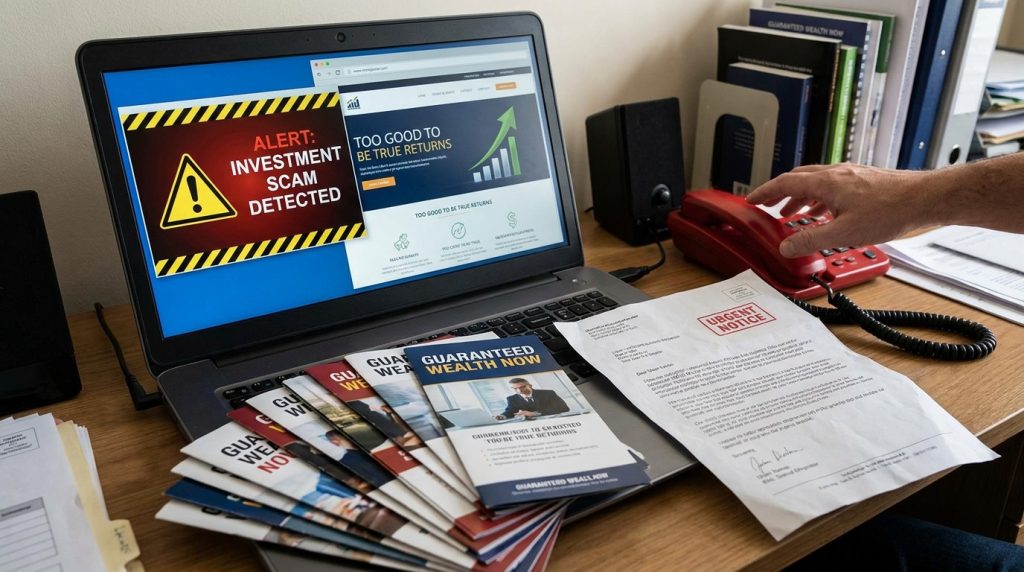
The Scale of the Problem
Investment fraud is large enough that traders should treat it as part of normal market risk management, not as a rare side issue. In the UK, City of London Police reported that criminals stole £879.8 million through investment fraud in 2025, with 34,673 people reporting cases and average losses of £25,612 per victim. Those figures came from Report Fraud data after it replaced Action Fraud in December 2025, and they show how much damage is being done outside the clean world of exchange prices and broker statements.
The US numbers tell the same story with a larger bill. The FTC said reports showed more than $7.9 billion in losses to investment scams in 2025, with a median individual loss of more than $10,000. Its warning on how to spot investment scams also notes that scammers reach people through social media, WhatsApp, online ads and personal relationships before showing fake proof of profits.
The FBI’s 2025 Internet Crime Report also points to investment fraud as a major driver of cyber enabled losses. Its release on cryptocurrency and AI scams says cyber enabled crimes defrauded Americans of nearly $21 billion, while investment fraud accounted for nearly 49% of scam related losses. Crypto related complaints alone totalled more than $11 billion in reported losses.
These numbers are reported losses. They are not the full market. Many victims do not report because they feel embarrassed, they still hope the money can be recovered, or they are afraid of admitting the loss to family members. Scammers know this. Silence is part of the business model.
The newer problem is quality. Fraud has become cleaner, faster and more personal. AI generated videos, cloned voices, fake adverts and copied websites have made scam material look less like spam and more like normal marketing. The old scam email from a prince with grammar problems still exists somewhere, probably enjoying semi retirement. The current version looks like a private equity teaser, a trading app, a bond desk, or a polite adviser with a LinkedIn profile.
How Investment Scams Usually Begin
Most investment scams start with contact that feels casual, helpful or urgent. It can be an advert, a direct message, a WhatsApp group, a cold call, a fake comparison site, a dating app conversation, a referral from a “friend”, or a search result that leads to a cloned broker website.
The first contact is rarely aggressive. It may begin as education. The scammer offers market commentary, a free signal, a webinar, a small trade idea, or a guide to passive income. The target is not asked for life savings on day one. That would be too obvious. The first aim is to start a conversation and move it into a private channel where there is less outside scrutiny.
Once the conversation moves, the scammer builds confidence. They may discuss inflation, interest rates, gold, crypto, AI stocks, property, private credit, pension transfers or forex. The details change with the market mood. When crypto is rising, the scam is about crypto. When rates are high, the scam is about fixed income. When property is popular, the scam is about development finance. Same engine, different paint job.
The next stage is proof. A fake dashboard may show early gains. A small withdrawal may be allowed. A fake account manager may send screenshots of other clients making money. The target starts to feel that the opportunity is real because it appears to be working. That is the trap. Early proof is often staged because it makes the later request easier.
A common pattern is the test deposit. The investor sends £250, £500 or £1,000. The account rises. The platform says the strategy is performing well. The “adviser” says the investor should add more before the next market move. The pressure increases only after trust has been built. By then the victim is not just evaluating an investment. They are defending a decision already made.
This is why traders can be vulnerable even when they understand markets. Trading knowledge does not always protect against social engineering. A trader may know how leverage works, yet still be fooled by a cloned firm. An investor may understand bonds, yet still buy a fake fixed income product using a copied brand. Market knowledge helps, but only if it is paired with identity checks, custody checks and boring verification.
Common Types of Investment Scams
Fake Trading Platforms
Fake trading platforms are among the most common investment scams because they are easy to dress up. The investor sees a login page, charts, balances, open positions and profit history. It feels like a broker account. The problem is that the account is controlled by the scammer. The numbers on screen do not prove that any trade has been placed.
Fake platforms often claim to offer forex, CFDs, binary options, commodities, crypto or stocks. The product choice matters less than the withdrawal process. Deposits are smooth. Withdrawals are not. The investor may be told to pay tax, release fees, verification deposits or compliance charges before funds can be returned. Real brokers deduct normal costs through account systems. They do not usually demand a separate payment to release profit.
The danger for traders is that fake platforms can copy real trading language. A scammer can talk about nonfarm payrolls, spreads, liquidity, order flow and gold breakouts. None of that confirms execution. A fake cockpit still has buttons.
Forex and CFD Scams
Forex and CFD scams sit in a grey area because forex and CFDs are real trading products. The scam is usually not the instrument itself. The scam is the broker, account manager, signal seller or platform making claims that cannot be verified.
A fraudster may claim to be an expert trader who can manage accounts for a fixed weekly return. Another may sell signals with “90% accuracy”. Others clone the branding of real brokers and use copied firm reference numbers. The victim thinks they are dealing with a regulated firm, but the phone number, payment address or website belongs to the fraudster.
A serious forex or CFD broker can still lose a client money through normal market movement. A fake broker does not need the market to do anything. It just needs the client to deposit.
Crypto Investment Scams
Crypto scams are so common because crypto transfers are fast, global and hard to reverse. The scammer may first ask the victim to buy crypto from a real exchange. That part can make the process feel legitimate. The problem comes when the victim sends the crypto to a wallet, trading platform or staking product controlled by the scammer.
Fake crypto platforms often show large gains. Some allow a small withdrawal to build confidence. Then the victim is pushed to add more money. When they ask to withdraw a larger amount, the platform demands taxes, gas fees, verification charges or anti money laundering deposits. The scam can continue for weeks because the victim is chasing a balance that appears large on screen.
Crypto romance scams, often called pig butchering scams, add emotional manipulation. The scammer builds trust through regular conversation before introducing the investment. The victim may believe the person is a friend, romantic partner or mentor. That relationship makes the fake profit display more convincing.
The asset is not always fake. Bitcoin is real. Ether is real. Large exchanges are real. The scam is the custody and sales path. If the investor cannot verify who controls the wallet, whether the platform is registered, or whether withdrawals work without extra payments, the asset label does not offer much comfort.
Fake Bonds and Fixed Income Offers
Fixed income scams target people who want lower volatility. That makes them dangerous. Many investors who would avoid a crypto presale will happily read a bond brochure because it sounds more serious.
A fake bond scam may use the name of a real bank, asset manager or government linked body. The investor is offered a rate that looks attractive but not absurd. That is clever. A promise of 40% a month screams fraud. A promise of 8% or 10% in a high rate environment may feel possible. The scammer knows where the line sits.
The FCA’s page on protecting yourself from scams warns that scammers may sound knowledgeable, claim authority, pressure people to act quickly and offer returns that appear too good to be true. It also lists common investment scams including bond and boiler room scams, forex scams, cryptoasset scams, binary options scams and recovery room scams.
The check is simple but not always quick. The investor must verify the firm through official channels, confirm the product exists, check whether the contact details match the regulator’s register, and avoid sending money to an account that does not clearly belong to the authorised firm. A real bond will survive a slow verification process. A scammer will not enjoy it, which is a useful clue.
Ponzi Schemes and Private Investment Clubs
Ponzi schemes pay old investors using money from new investors. They can be wrapped in almost anything: trading, property, crypto, private credit, commodities, sports betting, foreign exchange, invoice finance or AI investing. The outside story changes. The payment structure stays the same.
The returns are usually too smooth. Real strategies have drawdowns. Even skilled managers have losing periods. A private investment club that pays exactly 3% every month, regardless of market conditions, is not proving skill. It is proving the account statement has no respect for reality.
Affinity fraud is a related version where the scammer targets a group built on trust. The group might be religious, ethnic, professional, military, local or social. The SEC’s definition of affinity fraud describes scams that prey on members of identifiable groups, often with fraudsters pretending to be part of that group or using respected insiders to spread the pitch.
The uncomfortable part is that victims may trust the messenger because they know them. The messenger may also be a victim. That is how the scheme spreads without every participant knowing they are spreading it.
Recovery Room Scams
Recovery room scams target people who have already lost money. The scammer offers to recover funds, trace crypto wallets, sue the broker, remove personal data, or release blocked withdrawals. A fee is required first. Then another fee. Then silence.
The FCA warns that people who have already been scammed can be targeted again, including by firms offering to recover money after an upfront payment. Its guidance calls these recovery room scams and tells victims to be careful after the first fraud because details may be sold to other criminals.
This is one of the nastier parts of investment fraud. The victim is not only financially damaged. They are also emotionally primed to believe the next person who says the money can be saved. That is why the second scam can be easier than the first.
Red Flags Traders and Investors Should Take Seriously
Guaranteed Returns
The most obvious red flag is still the most useful one: guaranteed high returns. FINRA’s investment fraud red flags says investors should be suspicious of anyone who guarantees performance or promises a high return, because all investments carry some degree of risk.
This does not mean every fixed return is fraudulent. Bonds, deposits and some lending products can have fixed payments. The question is whether the promised return matches the borrower, collateral, regulation and risk. A high fixed return from a weak, unknown or unregulated issuer is not income. It is a question mark with a coupon.
Pressure to Act Quickly
Scammers hate time. Time lets the investor search the firm name, ask a regulated adviser, call the official number, read documents, check Companies House, compare yields, speak to a bank, or simply calm down. So they add pressure.
The offer may close today. The allocation may be nearly full. The bonus may expire. The trader may need to deposit before the next signal. A private placement may have one space left. This is sales theatre. Real investments can have deadlines, but legitimate sellers do not usually collapse when an investor asks for a day to verify basic facts.
Pressure works because markets move. Traders know missed trades hurt. Scammers exploit that feeling. They turn patience into fear, and fear is expensive.
Secrecy and Exclusivity
A scam may be described as private, invitation only, confidential or not available to ordinary investors. Some real investments are private, but secrecy is not proof of quality. It is often a way to stop the victim asking for outside opinions.
FINRA also warns about requests for secrecy, especially when the salesperson tells the investor not to tell anyone else or to bring friends into the sale. That behaviour is not normal due diligence. It is containment. The scammer wants the victim inside the bubble.
Overly Smooth Returns
Traders should be suspicious of returns that are too steady. Markets are not steady. Even conservative portfolios move. A private strategy showing consistent gains every week, with no volatility and no losing periods, deserves close inspection.
This is especially true when returns are shown only through platform screenshots or PDFs sent by the promoter. Real performance can be verified through custodian statements, audited accounts, broker records, fund administrators or regulated reporting. Fake performance usually lives in the same place as fake luxury watches: close up photos and bad lighting.
Unclear Custody
Custody means who actually holds the money or asset. In many scams, this is the weakest point. The investor may think they are buying a product, but they are really sending money to a personal account, crypto wallet, payment processor or offshore company unrelated to the claimed investment.
If the payment account name does not match the authorised firm, stop. If the seller gives excuses about payment routing, stop. If the investor is told to mark the payment as a gift, family transfer or consultancy fee, stop harder.
How to Check Whether an Investment Is Real
The first check is regulatory status. In the UK, the FCA Warning List lets investors search firms and individuals the regulator is concerned may be operating without permission. The FCA also says almost all UK financial services firms must be authorised or registered, and it warns that dealing with an unauthorised firm can mean losing access to the Financial Ombudsman Service and FSCS protection.
The second check is contact details. Do not rely on the phone number, email address or link in the offer. Use the regulator’s register or the firm’s official website found independently. Clone firms often copy the name and registration number of a real business but use different contact details. This is boring to check. Good. Boring checks save money.
The third check is documentation. A real investment should have clear documents explaining what is being bought, who issues it, what risks apply, what fees are charged, how money is held, how returns are produced and how exits work. Vague claims about AI, arbitrage, private banking access, secret liquidity or institutional trading are not documents. They are fog machines.
The fourth check is payment flow. Money should go to an account in the correct legal name, under the right jurisdiction, with a clear relationship to the investment. Crypto wallet transfers need even more care because reversals are usually not available. If the payment path looks strange, the deal is strange.
The fifth check is independent sense. Compare the promised return with ordinary market rates. If investment grade bonds yield far less than the offer, ask why this issuer is paying so much. If a forex trader claims no losing months, ask for broker verified records. If a crypto platform promises fixed yield, ask where the yield comes from. If a property scheme guarantees returns before planning approval, read that sentence again slowly.
What to Do After Sending Money
If money has already been sent and the investment now looks suspicious, speed matters. Contact the bank or payment provider first. Some payments may be stopped, traced or reported. Crypto transfers are harder, but transaction details should still be saved.
Do not send more money to release funds. That is the classic second payment trap. Taxes, compliance deposits, wallet unlocking charges, withdrawal fees and recovery fees are often just new labels for the same theft. If the platform says the investor must pay more before withdrawing, assume the risk has become severe.
Evidence should be saved before websites, chats and accounts disappear. Keep emails, WhatsApp messages, Telegram handles, phone numbers, bank details, wallet addresses, account statements, screenshots, contracts and payment confirmations. The trading scam guidance at Investing.co.uk also recommends gathering evidence and contacting the bank quickly where payment details may be at risk.
In the UK, suspicious firms can be reported to the FCA, while broader fraud reports now go through Report Fraud. In the US, the FTC directs victims to ReportFraud.ftc.gov, and the FBI encourages cyber fraud victims to report through IC3.gov. Reporting may not guarantee recovery, but it can help investigations and may prevent other investors being pulled into the same scheme.
Be careful with recovery services. Some legitimate lawyers, insolvency practitioners and claims firms exist, but scammers aggressively target victims after the first loss. No honest recovery agent can guarantee recovery before reviewing the case. A demand for upfront crypto, gift cards, secrecy or remote device access is a fresh warning sign.