Trading scams work because they copy the parts of trading that already feel normal. A trader expects platforms, charts, spreads, volatility, account managers, price feeds, signals, broker links, risk warnings and fast decisions. A scammer only has to make those pieces look convincing enough for the first deposit.
That is why trading scams can catch people with basic market knowledge. A complete beginner may not know what they are looking at. A trader with some experience may recognise the terms and relax too early. They may know what leverage is, understand a candlestick pattern, follow crypto prices or trade forex pairs, then still lose money because the broker is cloned, the platform is fake, the influencer is paid, or the recovery agent is running scam number two.
The loss does not always come from a bad trade. Sometimes there is no real trade. Sometimes the trade is shown on a fake dashboard. Sometimes the balance is fabricated. Sometimes the platform allows small withdrawals to build trust, then blocks larger ones. Sometimes the broker is a copy of a legitimate firm, down to the logo and licence number.
The instrument being promoted may be real. Forex, CFDs, options, crypto, prop trading, copy trading and short term speculation are not automatically scams. The scam is often in the person selling access, the platform holding the funds, the claim being made, or the withdrawal process that suddenly grows teeth.
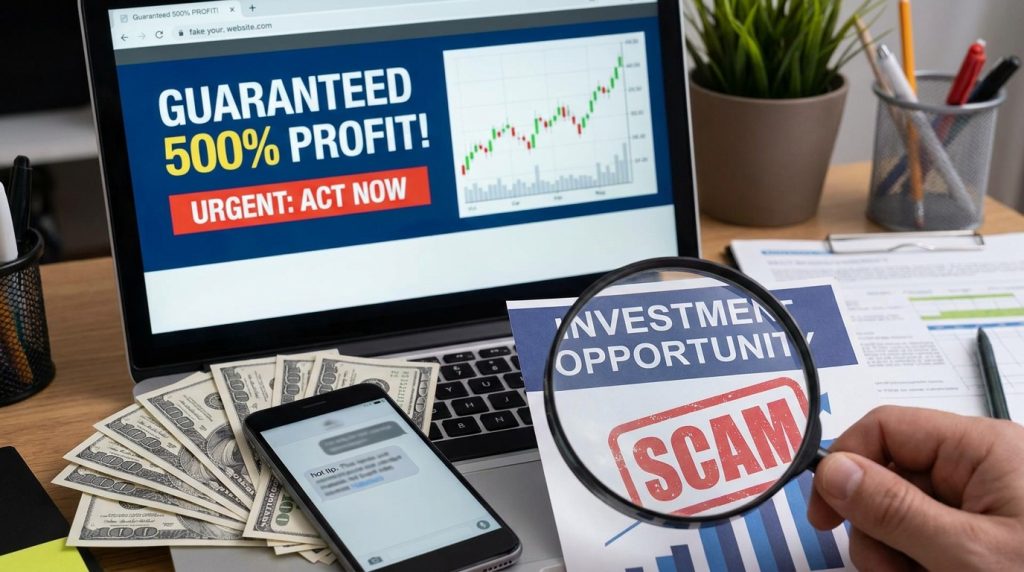
How Trading Scams Work
Trading scams usually begin by creating trust quickly. The scammer needs the victim to believe three things: the platform is real, the person promoting it is credible, and the money can be withdrawn later. Once those beliefs are in place, the deposit becomes much easier.
The first stage is usually exposure. The trader sees an advert, video, message, search result, fake review, comparison page, social media post or private invitation. The offer may involve forex signals, crypto trading, binary style trades, copy trading, funded accounts, AI bots, options strategies or broker access. The product category changes, but the emotional message is similar: faster gains, easier trading, better access, less effort.
The FTC’s investment scam guidance warns that scammers often promise high returns with little risk, time or effort. That warning applies cleanly to trading scams because many pitches sell trading as controlled income rather than high risk speculation. A real trading strategy may have an edge. It will also have losses, drawdowns, fees and bad periods. If those are missing from the pitch, the pitch is incomplete at best.
The second stage is movement into a private channel. The public ad or video may be fairly mild. The stronger claims happen in direct messages, WhatsApp, Telegram, Discord or a phone call. Private contact lets the scammer control the information, flatter the victim, answer objections and apply pressure without public scrutiny. It also avoids comments from people asking inconvenient things like “who regulates this firm?” which is poor for scam conversion rates.
The third stage is the small deposit. The victim may start with an amount that feels manageable. The platform shows profits. The account manager becomes more attentive. The trader may be told they are ready for a larger account, premium signals, higher leverage, a better payout tier or an exclusive market move. The initial deposit was not the destination. It was a test.
The fourth stage is escalation. The victim is encouraged to send more. This may be framed as opportunity, urgency or recovery. A market event is coming. A signal is live. A bonus expires. A larger balance is needed to release profits. A losing trade can be recovered with a bigger deposit. The scammer keeps the victim moving.
The fifth stage is withdrawal failure. The trader asks for money back and suddenly the rules change. Tax clearance, account upgrade, compliance release, liquidity fee, wallet validation, anti money laundering charge, broker commission, or settlement cost appears. The victim is told the money is ready, but one more payment is needed.
This structure works because each step feels close to normal trading. Deposits are normal. Volatility is normal. Fees are normal. KYC is normal. What is not normal is a firm demanding repeated fresh payments to release funds already shown in the account.
Broker Clone Scams And Fake Platforms
Broker clone scams are one of the most effective forms of trading fraud because they weaponise a sensible habit: checking regulation. The scammer copies a real firm’s name, logo, address, licence number or website style. The victim searches the name, finds a legitimate firm on a regulator register, and assumes they are safe.
That is one check too few.
The correct question is not only “does this firm exist?” The correct question is “am I dealing with that exact firm through its official website, official email, official phone number and correct legal entity?” A clone may use a similar domain, a different email ending, a mobile number, a chat app, or payment instructions that point to an unrelated company. Those details matter.
The UK regulator’s warning list for unauthorised firms tells consumers to be cautious of scammers pretending to be authorised firms and says they may be clone firms. It also advises people contacted unexpectedly by a financial business to reply using contact details from the official Firm Checker, not details supplied by the person making contact. That is boring, and also exactly the kind of boring that saves money.
The FCA’s separate guidance on clone firms and individuals explains that scammers often use the name, address or firm reference number of a genuine firm. This matters because a copied firm reference number can fool traders who stop after checking only the licence number. The contact details must match too.
Fake platforms are broader than clone scams. Some use a stolen identity. Others invent a new broker brand. They may show charts, account dashboards, trading history, market prices, support chat and mobile apps. Some are clumsy. Others look better than legitimate platforms, because web design is cheaper than compliance.
The platform may show real market prices copied from public data feeds. This creates confidence. The trader sees EUR/USD, gold, oil, indices or crypto prices moving in line with the public market. But a price display is not execution. A fake platform can show real prices while fabricating trades, balances and withdrawals.
The withdrawal stage is usually where the scam becomes visible. A real broker can delay withdrawals for identity or compliance checks. It can charge disclosed fees. It can reject a request if bank details do not match. But it should not keep demanding new deposits to release an existing balance. That is a classic fake broker pattern.
Clone and fake broker scams also create identity risk. Victims may upload passports, driving licences, bank statements, cards or proof of address. Regulated firms need KYC checks, so document requests are not automatically suspicious. Fake firms collect the same documents and may use them for identity fraud.
A trader should treat any broker as untrusted until verified independently. Not accused. Not guilty. Just untrusted. A serious broker can survive that status. A scam broker usually becomes irritated by it.
Finfluencer Red Flags And Social Media Funnels
Trading scams increasingly begin through finfluencers. The term covers people who discuss finance online, from serious educators to paid promoters to outright fraudsters. Some explain markets well. Some are inexperienced but loud. Some are sales funnels with a human face.
The problem is not that creators earn money. Education, research and media can all be businesses. The problem is undisclosed incentives. A finfluencer may make money from broker referrals, course sales, prop firm discount codes, signal subscriptions, copy trading fees, token allocations or affiliate links. A viewer may think they are watching neutral education when they are really watching paid acquisition.
A guide to finfluencer red flags in trading content is useful because the warning signs are often behavioural rather than technical. The creator may hide losses, exaggerate returns, push urgency, avoid regulation questions, overuse lifestyle proof, or move followers into private groups where the real selling starts.
The SEC’s investor alert on social media and investment fraud warns that fraudsters use social media to spread false information, impersonate trusted sources and promote schemes. Trading scams fit this exactly. A profile can build trust slowly through market commentary, then push followers toward a broker, group, token or managed account.
Social media also creates false proof. A screenshot of a winning trade is not verified performance. A withdrawal video is not proof that all customers can withdraw. A comment section is not due diligence. A rented car is not a trading record, though it does seem to have become the unofficial uniform of financial nonsense.
Signal groups are the usual next step. The creator posts public content, then invites viewers into Telegram, WhatsApp or Discord. Inside the group, members appear to be winning. They post trades, screenshots and thank you messages. Some accounts may be fake. Some may be earlier victims. Some may be paid promoters. The effect is the same: doubt starts to feel like being the only sober person at a very expensive party.
The group may push a specific broker. This is where the risk becomes practical. The promoter may earn from deposits or trading volume. The broker may be offshore, cloned, unregulated or fake. The signals may encourage overtrading. The “free” group may be a path into a paid tier, copy account, account manager or scam platform.
Copy trading is another area where promotion can hide risk. Copy trading can be legitimate through regulated platforms with clear performance data and risk disclosures. Scam versions present it as passive income. They show smooth returns without drawdowns, leverage, open losses, fees or the provider’s incentive structure. A trader copying a hidden martingale strategy may not understand the risk until the account breaks.
The phrase “not financial advice” does not fix any of this. It may be relevant in some educational contexts, but it does not make a misleading promotion safe. A creator who tells viewers what broker to use, what token to buy, what signals to follow and how much money they could make is influencing financial decisions, disclaimer or no disclaimer.
TikTok Trading Content And Short Form Risk
TikTok is especially useful for trading scammers because the format rewards confidence, speed and clarity. Trading usually offers none of those cleanly. A serious trading explanation needs time to cover risk, drawdown, execution, fees, stop placement, probability and failed setups. A short video can skip all that and show the win.
The TikTok investing report card highlights the problem of misleading finance content on short form video. The broad issue is not that every TikTok finance creator is fraudulent. Some are careful. Some teach basic concepts well. The issue is that the platform’s incentive structure rewards punchy certainty over slow accuracy.
A creator can show a chart after the move and make the entry look obvious. They can show one profitable options trade without showing the account curve. They can show a prop firm payout without showing failed challenges. They can show a crypto gain without showing whether viewers can exit at the same price. They can point to captions while leaving out the sentence that matters: “this may not work and you can lose money quickly.”
Short form trading content often compresses risk into decoration. The stop loss is not discussed. The position size is not disclosed. The broker relationship is unclear. The affiliate link sits quietly in the bio. The viewer is not given enough information to evaluate the trade, but enough excitement to keep watching.
The FTC’s cryptocurrency scam advice notes that crypto investment scams often start on social media or online dating platforms, and that crypto can be both the investment and the payment method. TikTok fits into this wider pattern because it can move users quickly from entertainment to deposit links, wallet connections or private exchange signups.
The danger for traders with basic knowledge is that the content may sound familiar enough to feel credible. A video may mention liquidity, order blocks, market structure, funded accounts, options premiums, staking, leverage, CPI data or forex sessions. These are real topics. The scam is often in what follows: the private group, the broker link, the fake bot, the managed account or the token sale.
TikTok can introduce trading ideas. It should not verify them. A video is not a regulator check. A creator’s confidence is not audited performance. A viral clip is not evidence that a broker pays withdrawals.
The safest approach is to treat short form trading content as marketing until proven otherwise. Some marketing is honest. Some is not. The trader’s capital should not be the test.
Crypto, Forex And High Risk Product Scams
Crypto and forex are common in trading scams because they are popular, volatile and easy to pitch online. The markets themselves are not scams. The risk is the fake platform, unsafe broker, false promise or payment method wrapped around them.
Forex scams often involve high leverage, managed accounts, expert signals or automated trading systems. The victim is told that an account manager or bot can trade major pairs, gold, oil or indices with steady profits. The platform shows gains. The trader deposits more. Withdrawal then fails.
The FBI guidance on cryptocurrency investment fraud explains that victims may be persuaded to send funds into fake investment platforms controlled by criminals, often after contact through online channels. The victim may see profits on screen while the real funds are already under the scammer’s control.
Crypto scams add wallet and payment risk. A trader may be told to deposit stablecoins into a platform, connect a wallet to a trading bot, buy a presale token, join a staking pool or pay fees to unlock withdrawals. The language may sound technical: gas, liquidity, bridge, node, smart contract, tax clearance, wallet validation. Some of these terms exist in real crypto. That does not make the demand real.
Academic research on cryptocurrency exchange scam patterns found large numbers of scam domains and fake apps imitating crypto exchange infrastructure. That supports what many traders already see in practice: scammers do not always need to steal through the trade. They can steal through the platform, app or domain.
High risk products such as CFDs, options, binary style contracts and leveraged tokens also appear in scams because they can produce fast gains in legitimate markets. That makes false claims sound more plausible. A scammer can point to a real chart that moved 10 percent and sell a fake system that claims to capture those moves reliably.
The product being real does not make the offer safe. A real instrument can be sold through a fake broker. A legal market can be used in a fraudulent pitch. An actual price feed can be shown on a platform that never executes a trade.
Recovery Scams After Trading Losses
Recovery scams target people who have already lost money. A victim loses funds to a fake broker, crypto platform, trading group or account manager. Later, someone claims they can recover the money. They may present themselves as a lawyer, regulator, investigator, blockchain analyst, bank officer, chargeback specialist or enforcement contact.
The pitch is designed around hope. The recovery agent says the funds have been traced, frozen or approved for return. The victim only needs to pay a tax, legal fee, insurance bond, wallet activation charge or processing cost. After payment, another fee appears. Then another.
A detailed warning on fund recovery scam tactics is relevant because trading scam victims are often targeted again. Once scammers know a person has paid once, that person may be placed on lists and approached by new operators. The second scam may be more polished because it refers to the first loss.
The SEC’s 2025 investor alert on SEC impersonators using social media and text messages warns that fraudsters may pretend to be SEC officials or employees and may claim to help recover money. This is the same recovery scam logic with an official looking costume.
Real recovery can sometimes happen through banks, card providers, payment firms, crypto exchanges, regulators, law enforcement or legal processes. But guaranteed recovery for an upfront fee is a serious warning. No legitimate regulator needs a victim’s seed phrase. No honest investigator needs remote access to a device. No real recovery route should require secrecy from police or the bank.
The most practical rule is harsh but useful: after a scam, treat every unsolicited recovery approach as suspicious. The person who sounds like the solution may be the next invoice.
Red Flags Before Funding An Account
Guaranteed returns are the first warning. Trading is not a fixed income product. A broker, signal seller, bot developer or account manager promising daily profit, no loss trading or fixed weekly withdrawals is making a claim that markets do not support.
Vague regulation is the second warning. A firm should identify its legal entity, regulator, licence number and authorised activities. Claims such as “globally licensed” or “internationally regulated” are weak unless they can be checked through an official register.
Payment mismatch is a major warning. Funds should not be sent to personal accounts, unrelated companies, unknown crypto wallets, gift cards or payment apps. The recipient should match the legal entity or a clearly disclosed payment processor.
Withdrawal fees that require new deposits are one of the clearest scam signs. Tax fee, release fee, liquidity fee, wallet activation, compliance clearance; the labels vary, but the structure is the same. The victim must pay more to access money already shown on screen.
Pressure is another warning. A real broker or educator can wait while a trader checks details. A scammer turns delay into danger. The bonus expires. The group closes. The signal is live. The account must be upgraded today.
Secrecy should stop the process. Scammers often tell victims not to speak with banks, regulators, family or other traders. They may say outsiders will not understand. This is isolation, not insight.
Fake proof is common. Screenshots, testimonials, dashboards, videos and luxury images are weak evidence. Verified statements, regulator records and withdrawal history matter more.
Remote access requests are dangerous. No broker, signal provider or recovery agent should need full control of a device. Remote access can expose bank accounts, passwords, email, identity documents and wallets.
Finally, contempt for questions is a red flag. Real professionals answer boring questions. Scammers resent them because boring questions break the script.
How Traders Can Verify Firms And Claims
Start with the legal entity. The brand name is not enough. Find the company name in the client agreement, terms and payment instructions. Then check that exact entity on the relevant regulator’s official register.
Compare details. The website, phone number, email, address, licence number and permissions should match official records. A near match is not enough. Clone scams rely on near matches.
Check the product permission. A firm may be registered for one activity but not authorised to offer CFDs, forex, crypto derivatives, investment advice or portfolio management to retail clients. The question is whether this entity can legally offer this product to you.
Ask how the promoter is paid. Broker referrals, spread sharing, course sales, prop firm codes, token allocations and copy trading fees all influence recommendations. Disclosure does not guarantee safety, but non disclosure is worse.
Read withdrawal terms before depositing. Look for fees, processing times, identity checks, bonus restrictions and account tiers. If withdrawal terms are vague, the trader should not fund the account.
Test information through independent routes. Do not use phone numbers or links supplied by the person making the pitch. Use official regulator websites, official firm sites and known complaint routes.
Keep records. Save broker terms, deposit receipts, trade confirmations, account statements, chat logs and withdrawal requests. If something goes wrong, records matter more than memory.
What To Do After Suspected Fraud
Stop sending money. Do not pay tax fees, release fees, wallet validation charges, account upgrades or recovery fees. A scammer asking for one more payment is usually extending the fraud.
Save evidence immediately. Capture websites, account dashboards, balances, trade history, payment instructions, wallet addresses, transaction IDs, emails, messages, usernames, phone numbers and identity documents sent.
Contact the bank, card provider, exchange or payment service used. Ask whether the transaction can be stopped, recalled, disputed, frozen or flagged. Crypto transfers are harder to recover, but speed still matters if funds move through an identifiable exchange.
Report the fraud. U.S. victims can report internet enabled fraud through the FBI Internet Crime Complaint Center, securities concerns through the SEC complaint process, and consumer fraud through the FTC fraud reporting portal. UK victims can report suspicious firms through the FCA scam reporting page and fraud through Report Fraud.
Tell someone trusted. Scams rely on embarrassment. A second person can help stop further payments and spot recovery fraud.