Binary options trading is simple on the surface, which is exactly why it attracts attention. A trader chooses whether a market condition will be true or false at expiry. Will EUR/USD be above this level at 3:00 p.m.? Will gold finish below a strike price? Will an index close higher than a certain point? If the trader is right, the contract pays a fixed amount. If the trader is wrong, the stake is lost.
That clean structure is both the selling point and the problem.
Unlike traditional investing, binary options do not involve ownership of an asset. Unlike standard options, they do not give open ended exposure to the size of a price move. The payout is fixed. The loss is fixed. The result is binary, hence the name. Win or lose. Yes or no. One or zero. It has the elegance of a light switch and, used badly, the risk profile of someone repeatedly touching it with wet hands.
For traders who want a broad introduction, broker comparisons and education material, BinaryOptions.net is one of the better known resources dedicated to the topic. It can be useful for learning the terminology, platform types and market structure before risking money. Still, education is not a substitute for regulation, risk control or common sense.
Binary options can be legitimate in some jurisdictions and through properly regulated venues. They can also be used by offshore platforms, fake brokers and aggressive sales operations. That split matters. The product structure is easy to understand, but the trading environment around it can be messy. Traders need to separate the contract from the people selling it.
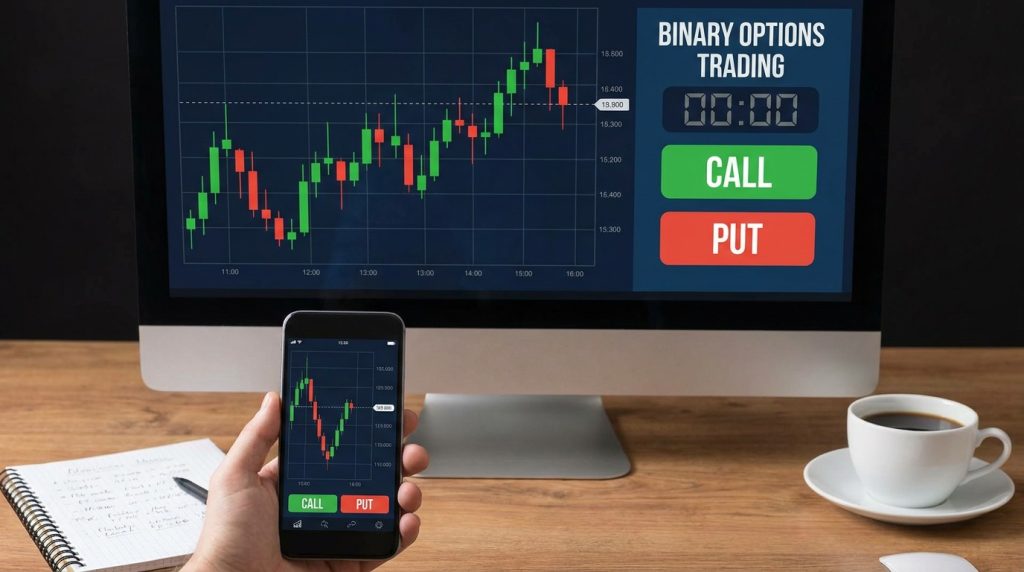
What Binary Options Are
A binary option is a financial contract based on a yes or no outcome. The trader is not buying a stock, currency, commodity or index. The trader is buying exposure to a specific proposition about that market.
A basic example looks like this. A platform offers a binary contract asking whether the S&P 500 will be above 5,300 at 4:00 p.m. The trader buys the contract. If the condition is true at expiry, the contract pays out. If the condition is false, the contract expires worthless.
The SEC’s explanation of binary options fraud describes binary options as contracts where the payout depends on the outcome of a yes or no proposition. That definition is useful because it removes the marketing fog. A binary option is not magic software, passive income or a secret strategy. It is a defined bet on a defined outcome.
The word “option” can confuse traders who already understand listed equity options. A standard call option or put option has a payoff that changes with the underlying price. If a stock moves far above the strike, a call option can gain more value as the move extends. If the move is smaller, the result changes accordingly. Binary options are different. Once the contract finishes in the money, the payout is fixed. Being right by one tick can produce the same payout as being right by a large move, depending on the contract design.
This can make binary options feel easier than standard options. There is no need to calculate delta, gamma, vega or complex time decay in the same way. The trade question is direct. The trader either expects the market condition to be true or not.
But simple does not mean easy. Predicting whether a market will be above or below a level at a short term expiry can be extremely difficult. Short time frames are noisy. Spreads, platform pricing and payout ratios matter. Small errors in timing can decide the result. A trader can have the right market view and still lose because the expiry is badly chosen.
Binary options also vary by structure. Some are based on price being above or below a level at expiry. Some are based on whether price touches a level during the contract period. Some are linked to ranges. Some use very short maturities, sometimes only minutes. The shorter the expiry, the more the trade starts to resemble a high speed probability game rather than a market thesis.
That is why traders should be careful with the phrase “easy to understand.” Binary options are easy to describe. They are not easy to trade profitably.
How Binary Options Trading Works
The mechanics usually begin with choosing an underlying market. This may be a currency pair, stock index, commodity, stock, cryptocurrency or event based market, depending on the venue and jurisdiction. The trader then chooses a contract condition, expiry time and stake.
In many retail platforms, the trader sees a fixed payout before entering. For example, a platform may offer an 80 percent return if the trade finishes in the money. A trader risking $100 could make $80 if correct and lose $100 if wrong. That payout ratio matters more than many beginners realize. If the average win pays less than the average loss, the trader needs to win more than half the time just to break even.
The break even calculation is simple. If a trader risks $100 to make $80, the required win rate before costs is about 55.6 percent. That is because five wins make $400, while five losses lose $500. A coin flip with this payout structure is not neutral. It is negative expectancy. The trader needs an edge, not just enthusiasm and a green button.
Some regulated exchange traded binary options work differently. In the U.S., the CFTC states that binary options can be traded on registered U.S. exchanges, while warning that many unregistered platforms promoted online may be fraudulent. On exchange style platforms, contracts may trade between 0 and 100, reflecting market pricing of the probability or payout value. A trader might buy at 40 and receive 100 if the condition is true, or zero if false. The risk and reward are still fixed, but pricing is market based rather than simply offered by a dealer.
This difference matters because the counterparty model can affect incentives. If a trader deals directly with an offshore platform that profits when customers lose, the trader should understand exactly how prices are formed, whether execution is fair and whether withdrawals are reliable. A regulated exchange model can reduce some conflicts because trades are handled under exchange rules, but it does not remove market risk.
Expiry is another major factor. A five minute binary option behaves very differently from a daily or weekly contract. Short expiries are more sensitive to noise, spreads and platform timing. Longer expiries may give a market view more time to develop, but they still require a precise final condition. A trader can be right for most of the session and wrong at expiry. The contract does not care about the emotional journey. It only cares about the final condition.
Market selection also matters. A liquid major currency pair during active hours may produce tighter pricing and more reliable movement than an obscure asset during quiet conditions. Index contracts around news events may move sharply. Commodities can react to inventory reports, weather, geopolitics and dollar moves. Crypto contracts can swing violently, and not always for reasons that make sense before coffee.
The practical process looks simple, but the edge calculation is not. A trader must know the payout, probability, expiry, volatility, event risk, platform rules and execution conditions. Without that, the trade is just a guess with a neat interface.
Why Traders Use Binary Options
Traders are drawn to binary options for several reasons. The first is defined risk. Before entering a trade, the maximum loss is known. That can be appealing compared with leveraged products where losses may expand quickly if risk controls fail.
The second attraction is the fixed payout. A trader knows the potential return before entering. There is no need to manage a moving profit target in the same way as spot forex, CFDs or futures. The trade either works or it does not. For people who struggle with cutting winners too early or moving stops around, that structure can feel cleaner.
The third attraction is market access. Binary options can offer exposure to currencies, indices, commodities and other markets through a single platform. A trader who already follows macro data, central bank decisions, earnings, oil inventories or technical levels may find the format familiar.
The fourth attraction is time control. A trader can choose short or longer expiries depending on the platform. This can suit people who prefer defined trade windows rather than holding open positions overnight. No overnight financing, no margin call in the traditional sense, and no debate over where to move the stop. The contract expires and the result is known.
But these advantages can turn into traps. Defined risk does not make a bad trade good. Fixed payout does not mean favourable payout. Fast expiry does not mean efficient trading. A platform that lets traders place many short term contracts quickly can encourage overtrading. The product can feel controlled while the behaviour becomes loose.
Binary options also appeal to traders who want simplicity. That is fair. Not everyone wants to model volatility surfaces or manage multi leg options spreads. But simple products can still require disciplined thinking. A one sentence trade setup can still be a poor setup.
Used carefully, binary options may serve as a tactical product for traders with a clear short term view and strict loss limits. Used casually, they can become financial arcade buttons. The difference is process.
Main Risks And Payout Structure
The main risk in binary options is the all or nothing payout. If the contract expires out of the money, the trader loses the stake. There is no partial credit for being nearly right. There is no extra reward for being very right unless the contract structure specifically allows early exit or market pricing changes before expiry.
This creates psychological pressure. A trader may watch a position move in the right direction, then reverse near expiry and expire worthless. That can lead to revenge trading. The next trade is entered quickly to recover the loss. Then another. Then another. Short duration contracts make this especially dangerous because the feedback loop is fast.
The payout structure also needs careful attention. If the offered payout is lower than the amount risked, the trader needs a win rate above 50 percent to break even. Many platforms advertise high payout percentages, but traders should calculate the required win rate before assuming the product is attractive.
For example, a contract paying 70 percent on a win and losing 100 percent on a loss requires a win rate of about 58.8 percent to break even. A contract paying 90 percent requires about 52.6 percent. These thresholds may sound achievable, but markets are not polite. A strategy that wins 55 percent of the time may still lose money if the payout is too low, execution is poor or the trader overtrades during bad conditions.
Another risk is pricing transparency. On a regulated exchange, market pricing and rules may be more visible. On some offshore retail platforms, the trader may depend heavily on the platform’s displayed price, expiry handling and execution logic. The CFTC and SEC investor alert on binary options warns that complaints have included platforms refusing to credit accounts, denying reimbursement, identity theft and manipulating trading software to turn winning trades into losses. That is not a minor footnote. It is the big ugly sign above the door.
Fraud risk is therefore part of product risk. A trader can understand the contract and still lose because the platform is dishonest. This is why binary options have a reputation problem. The structure itself is not the only issue. The sales environment around unregulated platforms has historically been full of trouble.
Another risk is short term noise. Many binary options are traded over brief windows. Over short periods, price movement may be dominated by spread changes, random order flow, news spikes and platform timing. A trader may have a correct larger market view but lose repeated short term contracts because the expiry windows are too tight.
There is also event risk. Economic releases, central bank decisions, earnings, employment data, inflation prints, oil inventories and geopolitical headlines can cause sharp moves. Binary options around these events may look attractive because direction seems clear. In practice, price can whipsaw hard. The first move is not always the final move.
Liquidity and exit rules matter too. Some binary options can be exited early, while others cannot. Some platforms allow selling before expiry. Others lock the trader in. The inability to adjust can be useful for discipline, but brutal when conditions change.
The biggest practical risk is behavioural. Binary options make it easy to reduce trading to streaks. Win, lose, double, recover, chase. That is not trading. That is letting the product’s simplicity flatten your judgement.
Regulation And Legal Access
Binary options regulation differs sharply by country. This is where traders must stop relying on general articles and check the rules that apply to them.
In the United States, binary options are legal only when traded on properly registered exchanges or designated contract markets. The CFTC’s binary options fraud page makes clear that binary options can be traded on registered U.S. exchanges, but also warns that many online platforms promoting binary options are unregistered and may be fraudulent. U.S. traders should be very careful with offshore websites that accept deposits while avoiding U.S. registration.
In the United Kingdom, the position is much stricter for retail consumers. The FCA confirmed a permanent ban on the sale of binary options to retail consumers, calling them gambling products dressed up as financial instruments. It also warned that any firm offering binary options services to UK retail consumers is likely to be a scam. That is unusually blunt for a regulator, which should tell traders something.
Across the European Union, the European Securities and Markets Authority introduced product intervention measures against binary options for retail clients. ESMA later renewed its prohibition, with its notice on the renewed binary options prohibition stating that the marketing, distribution or sale of binary options to retail clients had been prohibited since July 2018 under its temporary measures. Many national regulators then adopted local restrictions.
The practical lesson is simple. Binary options access depends on where the trader lives, which entity offers the product, and whether the venue is properly authorized. A platform saying “we accept global clients” does not answer the legal question. It may actually create more questions.
Traders should also avoid assuming that a regulator badge on a website is real. Fraudulent platforms often copy license numbers, names and logos. The only useful check is to visit the regulator’s own register and compare the legal entity, license status, approved activities, website domain and contact details.
Regulation does not make a trade profitable. It does not remove the all or nothing payout. It does not guarantee good decisions. But it can improve the chance that pricing, custody, complaints and withdrawals follow defined rules. In binary options, that difference matters a lot.
Broker And Platform Selection
Choosing a binary options platform should start with legality and regulation, not payout percentages. A high advertised payout is worthless if the platform blocks withdrawals, manipulates expiry prices or operates outside the rules that apply to the trader.
The first check is the legal entity. The brand name on the homepage may not be the company holding funds. Traders should read the terms and identify the exact company behind the account. Then they should check that company against the relevant regulator’s official register.
The second check is product permission. A company may be registered for one activity but not authorised to offer binary options to retail clients. Company registration is not the same as financial regulation. This distinction matters, especially when dealing with offshore firms or platforms that use vague language such as “internationally regulated” or “globally licensed.”
The third check is withdrawal history and rules. Before depositing, traders should read how withdrawals work, what identification is required, whether fees apply, whether bonuses create restrictions, and how long processing takes. Withdrawal terms should be clear. If the platform is vague before deposit, it is unlikely to become helpful after profit.
The fourth check is pricing and expiry rules. Traders need to know what price source is used, how expiry is calculated, whether there is early closure, whether quotes can be rejected, and how disputes are handled. A one tick difference can decide a binary option. That makes calculation rules important, not decorative.
The fifth check is account security. Two factor authentication, secure client portals, proper password handling and withdrawal controls matter. A trading account is not just a charting login. It is a financial access point.
Traders should also look at education and transparency. A platform that explains risk clearly is better than one that only shows winning examples. A provider that warns about loss probability may be less exciting, but excitement is cheap. Clear rules are worth more.
Resources like BinaryOptions.net and BinaryOptions.co.uk can help traders compare concepts, understand broker features and learn the language around binary options. Still, traders should verify any broker or platform independently before depositing. Reviews and guides are starting points, not permission slips.
Binary Options Strategy And Risk Control
A binary options strategy should begin with the payout math. Before thinking about entries, the trader must know the required win rate. If the payout is poor, the strategy must be very accurate to survive. A trader who ignores this is building a system on sand and hoping the tide respects technical analysis.
Market selection comes next. Traders should focus on markets they already understand. A currency trader may be better placed trading major FX pairs than random commodities. An index trader may understand session structure, opening ranges and economic releases better than crypto volatility. Familiarity does not guarantee profit, but unfamiliarity is rarely an edge.
Expiry selection is also central. Very short expiries can turn trading into noise prediction. Longer expiries may allow a thesis to play out, but they introduce different risks. The right expiry should match the reason for the trade. If the setup is based on a five minute breakout, a daily contract may not fit. If the setup is based on a macro event, a sixty second option is probably just gambling with extra steps.
Risk per trade should be small. Because binary options can expire worthless, traders should assume losing streaks will happen. Risking a large percentage of capital on each contract can destroy the account quickly. A trader using 10 percent of capital per trade needs only a short bad run to do serious damage. This is not advanced mathematics. It is how accounts get buried.
Traders should also set daily and weekly loss limits. Binary options can encourage quick re entry after a loss. A hard stop on trading activity can prevent a bad session turning into a bad month. The product does not force overtrading. It merely makes overtrading very convenient, which is close enough to be dangerous.
News trading needs care. Binary options around major releases may look attractive because movement is expected. But expected movement is not the same as predictable direction. Prices can spike both ways, spreads can widen and expiry levels can be crossed repeatedly. If a trader does not already have a tested approach to news volatility, binary options are a poor place to improvise.
Record keeping matters. Traders should track market, direction, strike, expiry, payout, reason for entry, result and emotional state. Without records, it is easy to confuse a lucky streak with a strategy. The market is very good at lending confidence before charging interest.
Who Binary Options Suit, And Who Should Avoid Them
Binary options may suit traders who understand short term market behaviour, can calculate expectancy, use strict risk limits, and trade through legal, regulated venues. They may also suit traders who want defined risk and fixed outcomes for a small portion of speculative capital.
They do not suit investors looking for long term wealth building. Binary options are not a substitute for diversified investing, portfolio construction, retirement planning or ownership of productive assets. They are short term speculative contracts. Calling them investments can make them sound more respectable than they deserve.
They also do not suit traders with poor impulse control. Anyone who tends to chase losses, increase size after losing, trade from boredom, or treat platforms like games should be careful. Binary options provide fast outcomes, and fast outcomes can feed bad habits.
Beginners should be especially cautious. The product looks simple enough for beginners, but the edge requirements are not beginner friendly. The trader must understand payout math, expiry selection, volatility, regulation, platform risk and fraud warning signs. That is a lot to manage while still learning how markets move.
A fair description is this: binary options are easy to place and hard to trade well.
Final Warning
Binary options trading is not automatically a scam, and it is not automatically a strategy. It is a high risk contract structure that can be legitimate in regulated settings and dangerous in unregulated ones.
The trader’s job is to separate product mechanics from sales pitch. Check the law in your jurisdiction. Verify the platform. Understand the payout. Calculate the required win rate. Limit risk. Avoid offshore firms that dodge regulation, pressure deposits or make withdrawals difficult.
A binary option gives a yes or no outcome. Before trading one, ask a better yes or no question: can this platform, product and trade setup survive proper scrutiny? If not, the best position is no position.